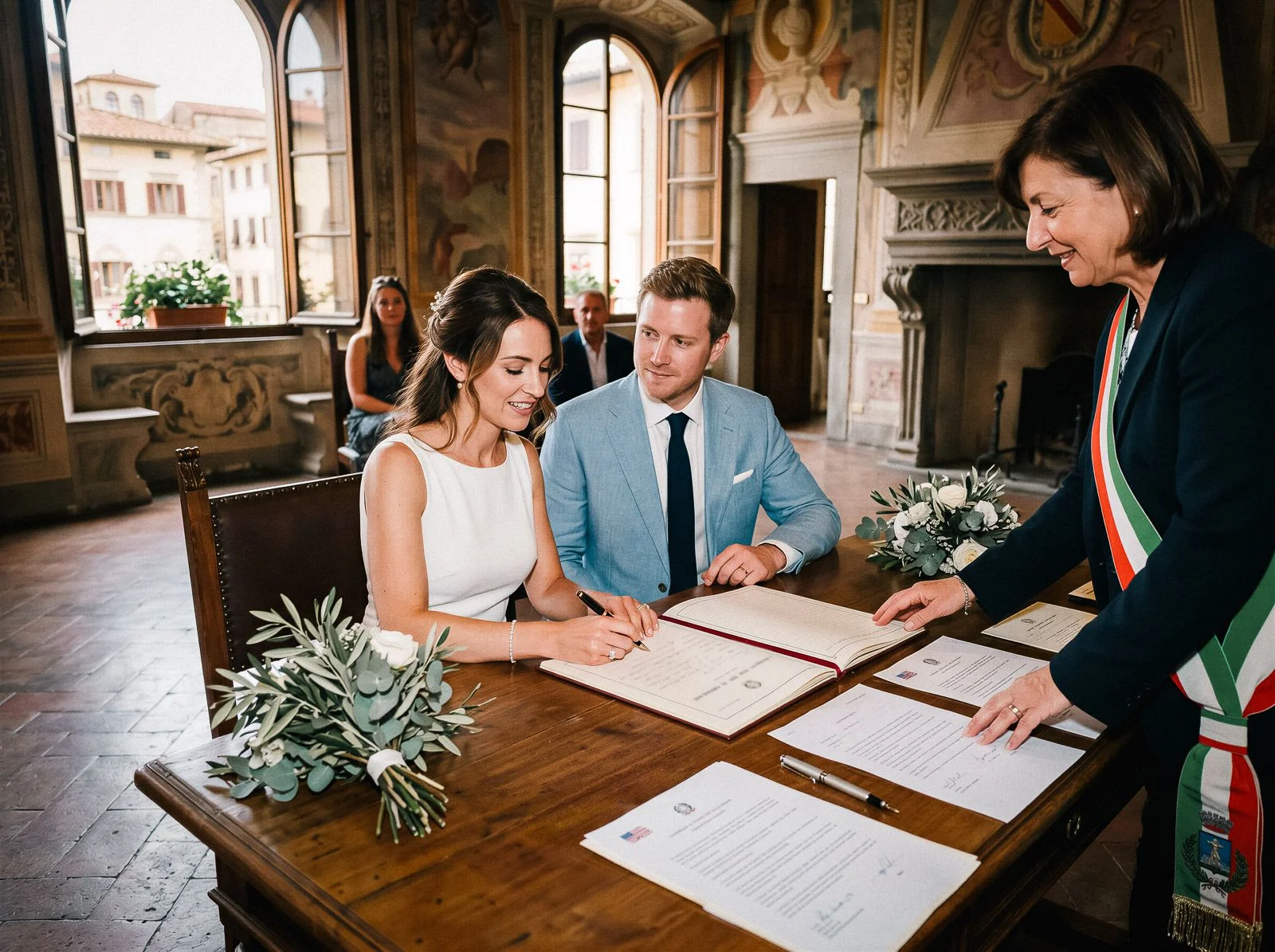
A civil wedding in Italy is entirely possible for foreign nationals. It is not reserved for Italian citizens, and there are no residency requirements. Couples from the United States, the United Kingdom, Australia, and dozens of other countries marry legally in Italy every year.
But possible is not the same as simple.
The process involves multiple institutions, documents that must be obtained in a specific sequence, translations that must meet particular standards, and timelines that leave little room for error. Understanding what is involved — before you begin — is the only way to approach it without unnecessary stress.
Two Routes to a Legally Recognised Marriage
For foreign couples, there are two ways to achieve a legally binding marriage in Italy.
The first is a civil ceremony conducted at the local town hall (comune). This is performed by the mayor or an appointed official, in Italian, and produces a marriage certificate recognised under Italian law and — with the appropriate steps — in your home country.
The second is a religious ceremony with legal standing. In practice, this applies almost exclusively to Roman Catholic ceremonies, which are recognised by the Italian state under a longstanding concordat. Other religious ceremonies may carry legal weight in certain circumstances, but the requirements vary and must be verified case by case.
For most international couples, the civil route is the relevant one. It is also the more flexible — it does not require religious affiliation, and it can be arranged at a wider range of venues and locations.
The Documents You Will Need
The exact documentation required depends on your nationality and personal circumstances. That said, most foreign couples will need to prepare some version of the following.
Valid passports for both partners.
Full birth certificates — not the abbreviated version issued for domestic use in many countries. Italy requires the long-form certificate that includes parents' names and details. This distinction catches many couples off guard.
A Nulla Osta — a certificate issued by your country's consulate or embassy in Italy, confirming that there are no legal impediments to your marriage. This is the document that causes the most friction. Consulate appointment availability varies, processing times fluctuate, and the requirements for obtaining it differ depending on nationality.
Apostille certification on any foreign documents — a form of international legalisation required by countries party to the Hague Convention. Without it, Italian authorities will not accept the documents.
Certified Italian translations of all foreign-language documents. These must be prepared by translators approved by the relevant consulate or Italian court — not any certified translator.
Divorce or death certificates, where applicable, if either partner has been previously married.
The Timeline
Six months is the minimum realistic preparation window. For many couples, especially those marrying in peak season when consulate appointments are harder to secure, eight months is more appropriate.
The sequence matters as much as the timeline. Documents cannot all be gathered simultaneously — some require others to be in place first. The Nulla Osta, for example, cannot be requested until other documentation is ready. Apostille certification must follow, not precede, the issuance of the original documents.
Most couples also need to arrive in Italy several days before the wedding date to complete final steps at the local comune. How many days depends on the municipality, the specific requirements of the location, and whether a local representative has been authorised to handle preliminary steps on the couple's behalf.
A Note on US and UK Couples
For US citizens, the Nulla Osta is issued by the American Embassy or the nearest US Consulate in Italy. The US Embassy in Rome and the Consulates in Milan, Florence, and Naples all handle this, but appointment availability varies significantly by location and season. The document is formally called an Affidavit in Lieu of a Certificate of Legal Capacity to Contract Marriage — a sworn statement confirming you are legally free to marry.
For UK citizens, the process changed after Brexit. British nationals no longer benefit from simplified EU procedures. The equivalent document is a Certificate of No Impediment, now obtained through a different consular process than before. British couples should verify current requirements directly with the British Consulate in Italy, as procedures have evolved in recent years and continue to be refined.
In both cases, the document must be obtained in Italy — not from the embassy or consulate in the home country.
Recognition at Home
A civil marriage performed in Italy is generally recognised in the couple's home country, provided the documentation was correctly handled and registered.
In practice, this means obtaining the Italian marriage certificate (atto di matrimonio) after the ceremony, having it apostilled by the Italian authorities, and — in most cases — registering it with the relevant authority in your home country upon return.
The specifics vary. Some countries register foreign marriages automatically through consular channels. Others require the couple to take active steps. Your local registry office or civil registration authority is the right point of contact for what applies in your specific case.
What This Process Actually Involves
Reading through the steps above, a pattern emerges: each element depends on another, each institution has its own timeline, and the margin for error is narrow.
A missing apostille means a rejected document. A consulate appointment that slips by a week can compress the entire timeline. A birth certificate ordered in the wrong format means starting that step again.
None of this is insurmountable. Couples navigate it every year.
It is, by any honest measure, a significant administrative undertaking — one that sits alongside all the other decisions involved in planning a destination wedding in Italy.
This is precisely the kind of process that benefits from someone who has navigated it many times before — who knows which documents to request first, which consulates have the longest wait times in which seasons, and how to build a timeline that holds.
How much of that process you want to carry yourself is a genuine question worth asking early.
The Alternative Most Couples Choose
It is worth naming what many international couples quietly decide: they marry legally in their home country — a brief, private appointment — and hold their Italian celebration as a symbolic ceremony.
This is not a workaround. It is a considered choice. The Italian day becomes entirely ceremonial — unburdened by institutional requirements, free to take place wherever and however the couple wishes.
If you are weighing this option, our guide on civil versus symbolic weddings in Italy explores the distinction in full.
TGK Perspective
The couples who choose a legal ceremony in Italy rarely do so because the paperwork appeals to them. They do so because they want one singular moment — the signing and the celebration, together, in the same place, on the same day. That desire is entirely valid, and we respect it.
What we also know, from years of managing this process across dozens of nationalities and municipalities, is that the gap between 'it is possible' and 'it went smoothly' is almost always a question of who is handling it — and how early they started.
When we manage the legal process for a couple, we take ownership of the entire sequence — the document checklist, the consulate coordination, the comune liaison, the certified translations, the timing. Not because couples cannot do it themselves, but because their attention belongs elsewhere.
That is, ultimately, what we are here for.