Most destination wedding budget guides are written backwards. They start with a number and build confidence around it, rather than building the number honestly from its components. This guide attempts the opposite: a systematic breakdown of every major cost category, by region, with ranges drawn from real Italian wedding planning rather than aspirational estimates.
It will not tell you what you want to hear. It will tell you what you need to know.
How to read this guide
The figures here are ranges, not quotes. Every wedding is different: guest count, venue selection, production ambition and timing all affect the final number. What these ranges give you is a calibrated starting point, the realistic boundaries within which your wedding will likely fall, and the variables that push you toward one end or the other.
All figures are in euros. Currency conversion to USD, GBP, or AUD adds variability depending on exchange rates at the time of each payment.
For context on what drives the difference between legal and symbolic wedding costs, read our overview of civil versus symbolic weddings in Italy.
Our five destinations: a regional overview
Lake Como
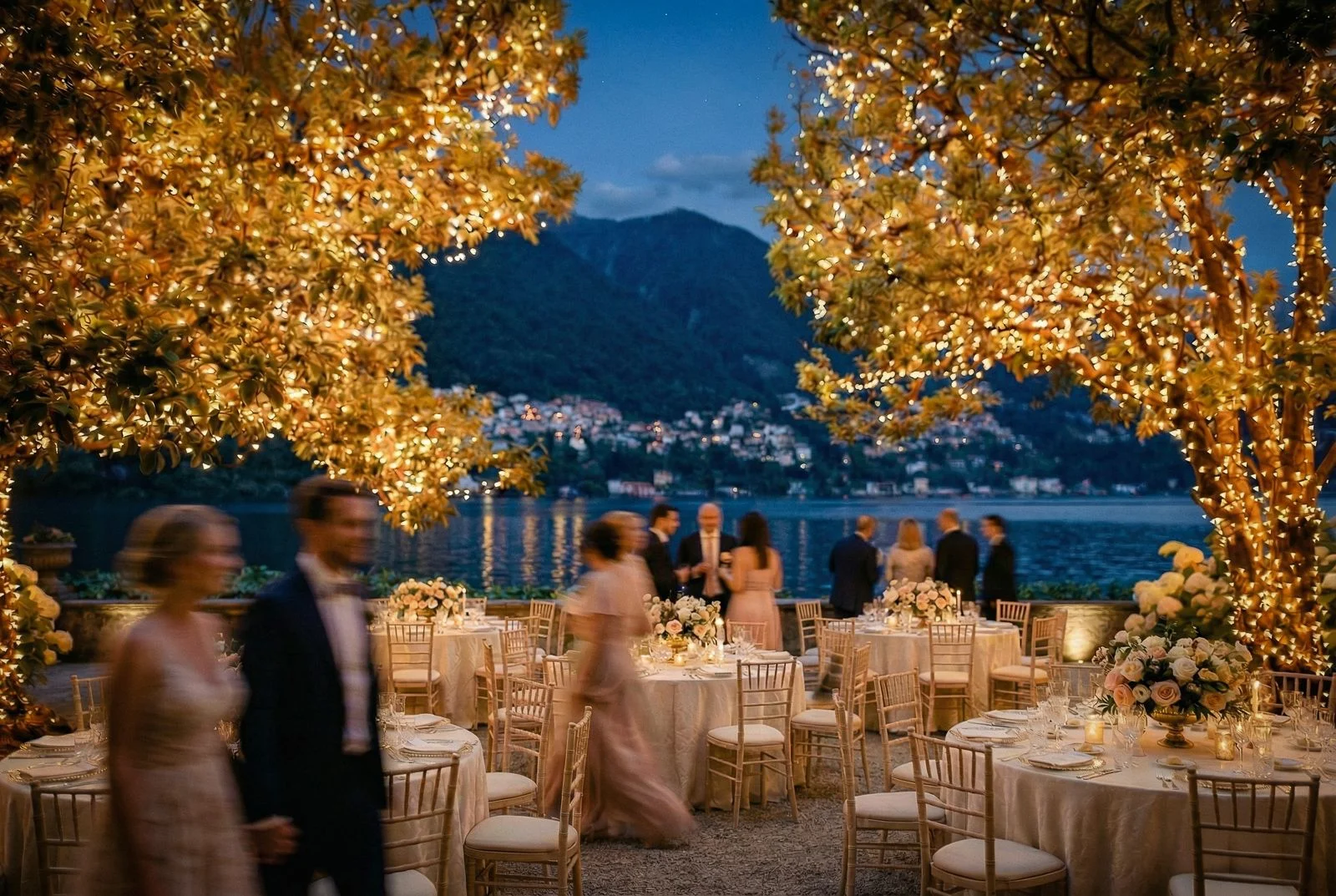
Lake Como is Italy's most internationally recognised wedding destination. The supply of exceptional properties is genuine (historic villas, lakefront estates, terraced gardens with unobstructed water views), but demand consistently outpaces availability at the premium end. This drives pricing.
Venue hire: €8,000 to €28,000 depending on the property, whether it is booked for sole use, and the length of the hire. Iconic lakefront villas with international profiles occupy the higher end. Catering per person (full dinner service): €180 to €280+. Florals: €5,000 to €25,000+ depending on scope. Photography (full day): €4,000 to €8,000. Videography: €3,000 to €5,500. Music (ceremony and reception): €2,500 to €8,000. Guest transfers: €2,500 to €6,000. Officiant (symbolic ceremony): €600 to €1,200.
Illustrative mid-scale total for 55 guests in peak season: €85,000 to €120,000.
Lake Maggiore and Lake d'Orta
Often described as Como's quieter counterpart, Lake Maggiore and the smaller, more intimate Lake d'Orta offer a slightly wider range of venue types and often better date availability. Lake d'Orta in particular, built around a single island sanctuary in the middle of a calm lake, attracts couples seeking something that reads as entirely singular.
Venue hire: €5,000 to €20,000. Catering per person: €160 to €260. Florals: €4,000 to €20,000+. Photography: €3,500 to €7,500. Guest transfers: €2,000 to €5,000.
Illustrative mid-scale total for 50 guests in peak season: €70,000 to €100,000.
Tuscany
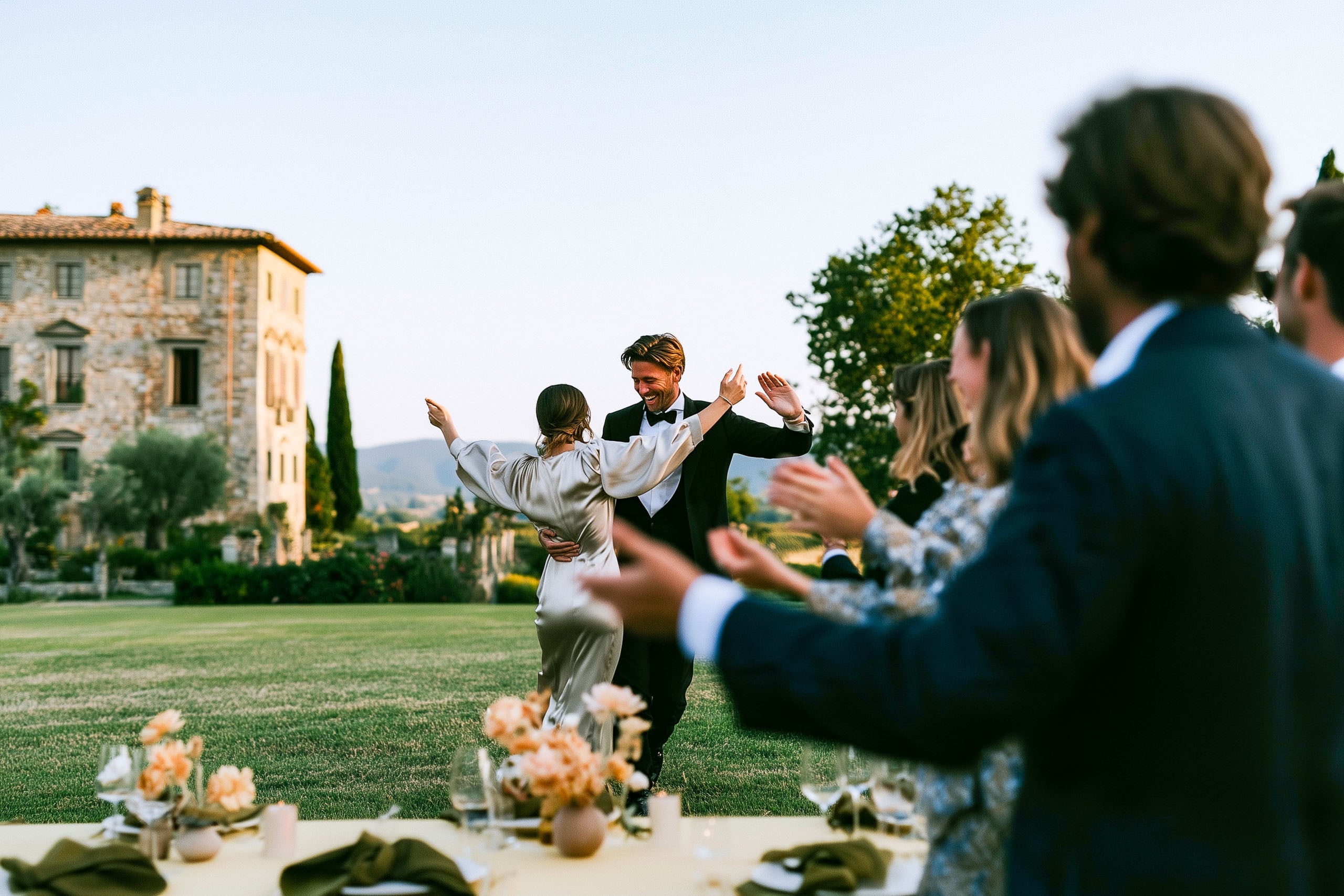
Tuscany offers the widest range of venue typologies across our destinations, from restored farmhouses in the Val d'Orcia to medieval borgo complexes in Chianti, from hilltop villas with panoramic vine views to estates with private chapels. This variety creates genuine budget flexibility: a Tuscan wedding can be planned beautifully at the mid tier in a way that the lakes cannot match.
Venue hire: €4,000 to €22,000, approaching €30,000 for the most sought-after private estates in high-demand corridors. Catering per person: €145 to €240. Florals: €4,000 to €20,000+. Photography: €3,500 to €7,500. Guest transfers: €1,800 to €4,500.
Illustrative mid-scale total for 60 guests in peak season: €65,000 to €95,000.
Shoulder season (April to May, late September to October) offers meaningful savings in Tuscany, particularly on venue hire and vendor availability. A wedding in late September in the hills carries the advantage of harvest light, one of the most photographically rich environments in Italy, at reduced season pricing.
Umbria
Umbria is consistently underestimated, which is part of its appeal. The hill towns of Assisi, Spoleto, Orvieto and the Valnerina offer medieval settings with a fraction of the international footfall of Tuscany. Venue hire tends to be more accessible, local vendor networks are skilled and experienced with international couples, and the calendar is less compressed.
Venue hire: €3,500 to €16,000. Catering per person: €135 to €220. Florals: €3,500 to €16,000+. Photography: €3,000 to €7,000. Guest transfers: €1,500 to €4,000.
Illustrative mid-scale total for 55 guests: €55,000 to €80,000. For couples with a genuine mid-tier budget who want Italy without compromise on quality, Umbria offers the most flexibility of any of our destinations.
Cinque Terre and the Italian Riviera
The most operationally complex destination, and visually among the most dramatic. The five cliff villages, the terraced lemon groves, the sea light that photographers describe as unlike anywhere else in Italy. But venue access here is genuinely difficult, vendor logistics require careful coordination, and the number of properties capable of hosting a full wedding is limited.
Venue hire: €5,000 to €20,000, with wide variation based on access and on how private the setting is. Catering per person: €160 to €260, reflecting the logistical complexity. Florals: €4,500 to €18,000+. Photography: €3,500 to €7,500. Guest transfers: €2,500 to €6,000+ for boat transfers and cliff access logistics.
Illustrative mid-scale total for 45 guests: €70,000 to €100,000. This destination rewards couples with a specific and clear vision. It is not the most accessible destination logistically, but for those it is right for, it is irreplaceable.
The categories most budgets miss
Accommodation for the couple and family
Most couples budget for their guests' accommodation but not their own. A suite at a fine hotel near the venue for the wedding night, and often for a two-night stay before and after, adds €1,500 to €4,000+ to the total. Where we manage an accommodation block for a larger guest group, the couple's rooms are typically negotiated within that block, but the cost is real.
Day-after events
A farewell brunch or day-after lunch is not mandatory, but in practice most couples include one. It is the gathering where the emotion of the wedding settles into warmth and memory. Budget €2,500 to €6,000 for a well-hosted farewell meal.
Welcome event
A welcome aperitivo or dinner the evening before the wedding (informal, warm, often hosted at a local restaurant rather than a venue) adds €1,500 to €4,000 depending on format and guest count.
Hair and makeup
A professional artist for the bride and sometimes the wedding party on the day: €600 to €1,500, plus travel.
Stationery and printing
Custom invitations, ceremony programmes, menus, and table assignments: €800 to €3,000 depending on production quality.
Gratuities
Italian vendor culture does include gratuities, particularly for venue staff and catering teams who have delivered a long day of service. Budget 5 to 10 percent of catering costs as a guideline.
IVA (Italian VAT)
Italian suppliers charge IVA at 22 percent on most services. Some quotes include it; many present the net price and add IVA on invoice. Always confirm which applies. Across a full vendor budget, this distinction can represent a significant sum.
Shoulder season and weekday savings
Every cost range in this guide assumes peak season (late May through mid-September) and a Saturday. Off these defaults: a peak Saturday moved to shoulder season typically reduces venue hire by 10 to 20 percent, with vendor fees less affected but more negotiable. A peak Saturday moved to a weekday, typically Thursday or Friday, reduces venue hire by 15 to 30 percent, and some vendors offer weekday discounts.
The combination of shoulder season and a Friday wedding can meaningfully shift a budget, particularly in Tuscany and Umbria where calendar pressure is lower than at the lakes.
What 'all-inclusive' packages actually include
Some venue packages in Italy are advertised as all-inclusive. In practice, this means catering is provided by the venue's in-house team and the package bundles a certain number of service hours, a set menu tier, and often basic table settings. What it does not include: florals, music, photography, transportation, or any production elements beyond the catering itself.
Understanding this distinction prevents budget surprises when a couple expects an all-in price and receives an invoice for everything the inclusive package excluded.
Working with a single point of contact
The regional cost ranges above cover vendor costs. What they do not capture is the operational reality of managing those vendors from abroad.
Italian wedding vendors do not accept credit cards. All payments are made by bank wire transfer in euros, typically across two or three milestone instalments per vendor. For a fully staffed wedding, a couple might otherwise be managing six to ten separate international wire transfers, in a foreign currency, to accounts they have never dealt with before. Most couples discover this late, when the first deposit is already due.
At The Gilded Knot, we handle every vendor payment on the couple's behalf. Couples make a single structured payment to us at each milestone; we manage all downstream transfers to every vendor in the network. The couple never wires money to a vendor directly, never navigates an Italian contract alone, and never has to coordinate between suppliers who do not share a language. For a full picture of how the Italian payment system works and why it matters, read our guide to Italian vendor payments.
Our Perspective
Financial transparency is not a feature of how we work. It is the foundation. Every couple we work with receives a full budget breakdown before any vendor is contacted. Not an estimate: a structured document with line items, realistic ranges for each category, and the variables that could move each one. We update it as the planning evolves.
What we have seen, over and over, is that couples who plan from real numbers make better decisions. They choose the venue that fits rather than the venue they fell in love with before understanding what it cost. They allocate their production budget to the elements that matter most to them, and let go of the ones that were attractive in editorial images but were never really them. That clarity does not diminish the wedding. It shapes it.
The most common source of budget overrun in Italian weddings is not dishonest vendors. It is the accumulation of things no one mentioned at the beginning. The IVA. The day-after brunch. The welcome dinner that felt optional in April and essential in July. Our job is to put all of it on the table at the start, so that the number we are working toward is the number we actually reach.
— The Gilded Knot
Frequently Asked Questions
What is a realistic total budget for a 50-person wedding in Italy?
For 50 guests in peak season, realistic totals range from approximately €65,000 to €95,000 in Tuscany or Umbria, and €70,000 to €110,000 at the Lakes. The spread within each region depends primarily on venue choice and floral production scope. A shoulder-season or weekday wedding can reduce these totals by 10 to 20 percent without meaningfully compromising the experience.
Which Italian region offers the best value for a destination wedding?
Umbria consistently offers the widest budget flexibility without sacrificing quality. Venue hire is more accessible than at the Lakes or premium Tuscany corridors, local vendors are experienced with international couples, and the landscape of medieval hill towns, stone estates and rolling valleys is genuinely beautiful. For couples prioritising atmosphere over international name recognition, Umbria delivers exceptional value at the mid and premium tiers.
How much should we budget for florals at an Italian wedding?
A tasteful but complete floral programme, with a ceremony installation, table centrepieces and some decorative elements, starts at approximately €4,000 to €6,000 for a mid-scale wedding. The installations seen in editorial wedding photography typically represent €15,000 to €30,000 in floral investment. Both are valid; the key is deciding early which level of production matters to you, since florals are one of the most variable line items in the entire budget.
Is it cheaper to get married in Italy on a weekday?
Yes. Weekday weddings (typically Thursday or Friday) can reduce venue hire by 15 to 30 percent compared to a Saturday in peak season. Some vendors offer weekday rates; others apply standard pricing regardless of day. The practical consideration is guest travel: a Thursday wedding requires most international guests to take additional days off work. For couples with a flexible guest list, a Friday in shoulder season is often the best balance of savings and attendance.
Does IVA (Italian VAT) apply to wedding vendor invoices?
Yes. Italian vendors charge IVA at 22 percent on most professional services. Some quotes present the total inclusive of IVA; others state the net price and add IVA separately on the final invoice. Always ask which applies before accepting a quote. Across a full vendor budget, the difference between a net and gross figure can represent several thousand euros, a number that should appear in your planning budget from the start, not as a surprise on invoice.
How do welcome dinners and farewell brunches affect the total budget?
These two events, an informal welcome gathering the evening before the wedding and a farewell meal the day after, are not mandatory, but most couples include at least one. Together they typically add €4,000 to €10,000 to the total, depending on format and guest count. They are often the events guests remember most warmly. Budget for them from the start rather than deciding mid-planning, when the overall figure is already set.
How does working with a planner affect the overall cost?
Working with a local planner is not an optional add-on in Italy. It is what makes the planning process functional for international couples. Language, vendor access, contracts, and a payment system with no credit card option all require a trusted local intermediary. The structure and scope of that service varies by studio. At The Gilded Knot, we explain the full picture in detail during your first conversation.
Build your budget with someone who knows the real numbers
Every wedding we plan begins with an honest budget conversation: no vague estimates, no fine print. Start yours here.