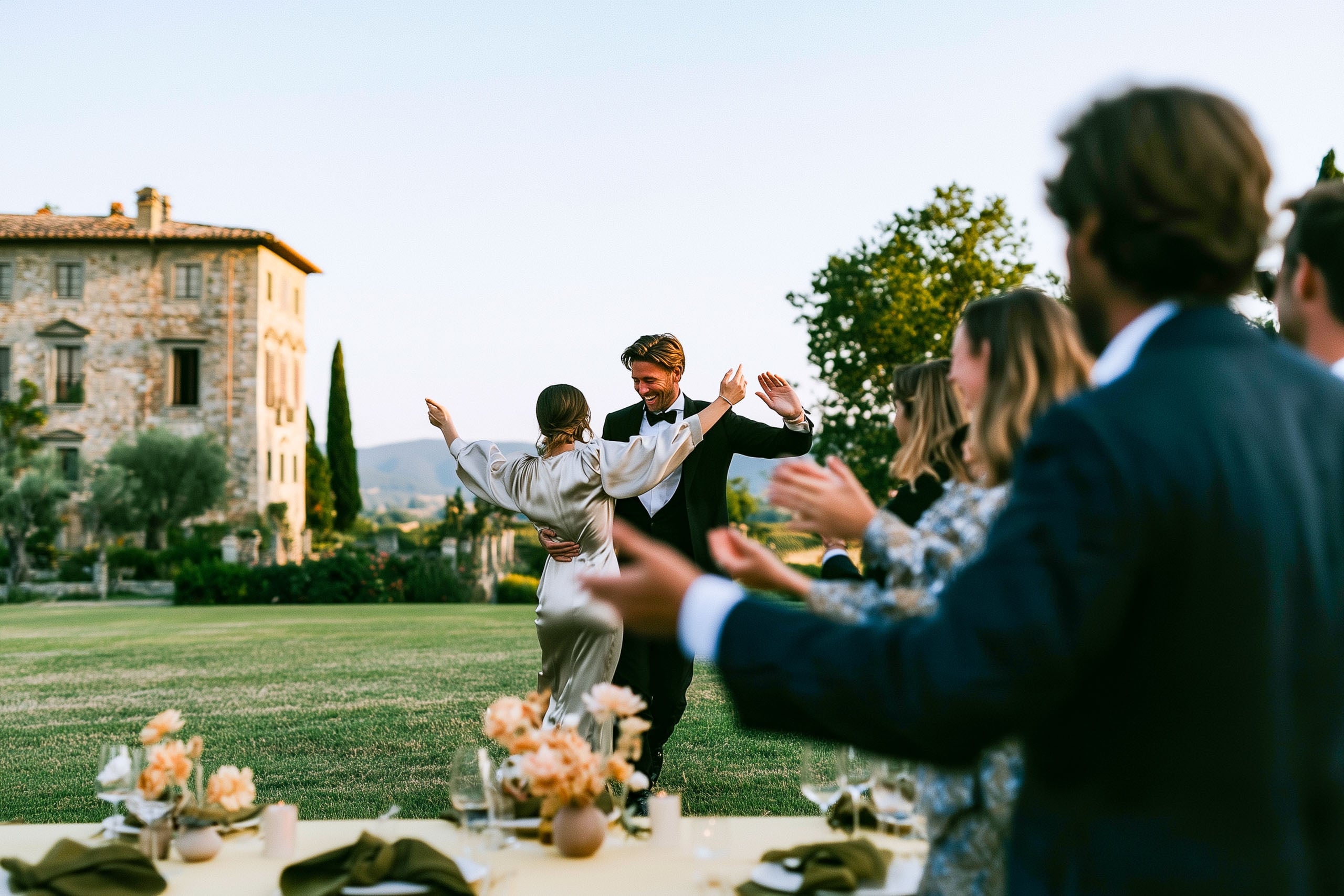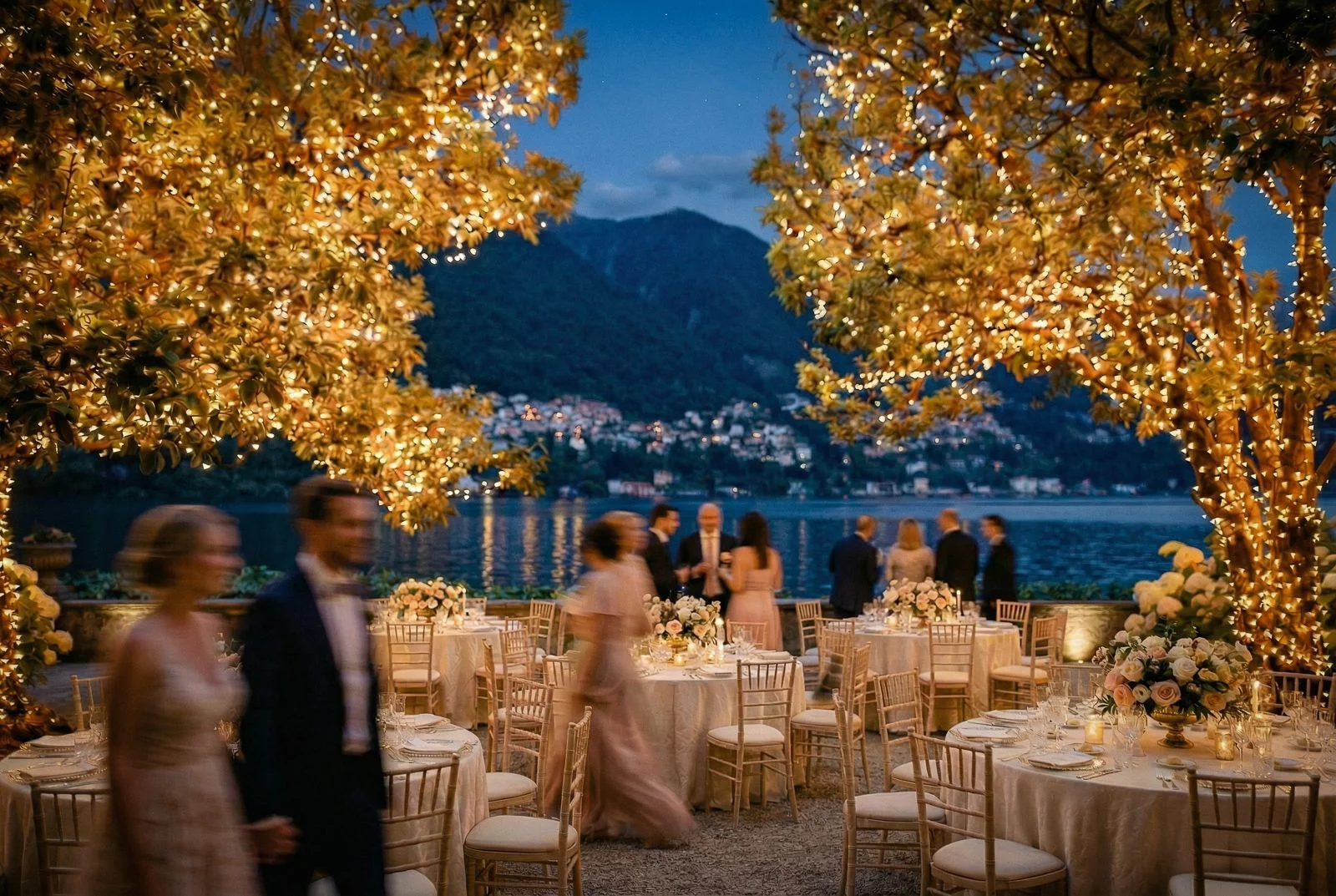
The question is asked carefully, often with a qualifier — we know it depends, or we understand every wedding is different. Both are true. But "it depends" is not an answer, and the destination wedding industry has made a habit of hiding behind it.
This article will not do that.
What follows is a genuine breakdown — by scale, by region, and by the categories that consistently surprise couples who have done their research and still find themselves underprepared. The figures are drawn from real weddings planned in Italy, not from brochures or aspirational estimates.
How much does a wedding in Italy cost at each scale?
Before looking at specific numbers, it helps to understand that wedding budgets in Italy follow a relatively consistent pattern across regions. The primary variables are guest count, venue category, and the level of production in florals and entertainment. A wedding for 30 guests at a private hillside villa and a wedding for 100 guests at a lakeside palazzo are not variations of the same event — they are fundamentally different productions.
The four tiers below describe what couples consistently end up planning, regardless of what they imagined when they started.
Intimate — 20 to 35 guests — €28,000 to €55,000
This is the tier where the expectation gap is widest. Many couples imagine that a small wedding means an inexpensive one. In Italy, intimacy reduces guest-count costs but does not proportionally reduce venue costs, florals, or photography. A dinner for 25 at a private estate still requires the estate, the flowers, the photographer, and the full production structure. The saving on catering is real; everything else remains largely fixed.
Mid-scale — 40 to 70 guests — €55,000 to €90,000
The most common tier for anglophone destination couples. Enough guests to animate a proper reception, not so many that logistics become the primary focus. Catering becomes the single largest line item. Venue selection has the most impact at this scale — the same 60-person wedding can cost significantly more or less depending on whether the venue is a historic property requiring full external catering, or an estate with in-house services.
Premium — 70 to 120 guests — €90,000 to €160,000
At this scale, production decisions compound. Florals that read beautifully at 50 guests need to be re-imagined to fill a larger space. Entertainment adds a second tier — often a band in addition to a DJ, or a live musician during dinner. Transportation logistics for guests require proper coordination. The venue selection becomes more constrained — fewer properties can handle this scale without compromising the atmosphere.
Production-led — beyond 120 guests, or any scale with fully custom production — €150,000 and above
This tier is defined less by guest count than by production ambition. Multi-day programmes, architectural floral installations, orchestral music, curated accommodation for guests across multiple properties. Budget ranges become less meaningful here because the variables are entirely particular to each commission.
How do costs differ between destinations?
The five regions where The Gilded Knot works are not interchangeable. Each has a different cost structure, a different venue supply, and a different character.
Lake Como
Lake Como is Italy's most internationally recognised wedding destination, which means demand is consistent and venue pricing reflects it. Lakefront properties command a premium, and the vendors with the deepest experience at this level in Italy are concentrated here — which raises quality but compresses negotiating room. Peak season (late May through mid-October) sees minimal flexibility on dates.
Lake Maggiore and Lake d'Orta
Often described as Como's quieter counterpart, Lake Maggiore and the smaller, more intimate Lake d'Orta offer a slightly wider range of venue types and often better date availability. Lake d'Orta in particular — built around a single island sanctuary in the middle of a calm lake — attracts couples seeking something that reads as entirely singular. Venue hire and catering tend to be somewhat more accessible than at Como, without any compromise on the quality of the landscape.
Tuscany
Greater variety in the venue supply translates to greater budget flexibility. A private farmhouse in the hills can be hired for considerably less than a lakefront villa, while still offering the visual language couples imagine when they think of an Italian wedding. Catering in the interior regions is often slightly more accessible than at the lakes, though the most sought-after properties in high-demand areas approach lake pricing during summer.
Umbria
Umbria offers a genuinely quieter alternative with excellent value at mid and premium tiers. The hill towns — Assisi, Spoleto, Orvieto — have the same medieval character as Tuscany at a fraction of the international footfall. Venue hire tends to be more accessible, local vendor networks are skilled and experienced with international couples, and the calendar is less compressed.
Cinque Terre and the Italian Riviera
The most logistically complex of the five destinations. Venue access, vendor transport, and guest movement all require careful planning in this terrain. The visual drama — cliffside terraces, sea light, village settings — justifies the operational investment for couples who have a clear vision. Venue hire varies enormously based on access and how private the setting is. Catering reflects the complexity of logistics. For access and seasons on each coast, see our guides to the Cinque Terre and the Italian Riviera, and what a wedding in Portofino involves.
Which costs do couples underestimate?
Catering per head — the number that moves everything else
Couples often estimate food and beverage costs from restaurant meal prices, which bears no relationship to event catering. In Italy, full wedding catering — aperitivo, seated dinner with wines, late-night service — typically starts from €200 per person and above, depending on region, property, and menu. The difference between the lower and higher end of the market represents a substantial sum when multiplied across a full guest list. This single line item can move the total budget by more than any other variable.
Local coordination — the infrastructure everything else depends on
A wedding in Italy requires a local planner. Without one, couples face language barriers, vendor relationships they cannot access independently, contracts written in Italian, and a payment system built entirely on bank wire transfers — with no credit card option at any stage. This is not an optional line in the budget. It is the infrastructure that makes everything else possible.
At The Gilded Knot, it means a single point of contact who manages every vendor relationship, every contract, every payment, and every logistical detail from first call to farewell brunch — so that couples are never dealing with Italy's complexity directly. The scope and cost of our service is explained in full during your first conversation.
Florals — the range is genuinely large
A tasteful floral programme for a mid-scale wedding — ceremony arch, table arrangements, some decorative elements — starts at several thousand euros and scales rapidly with ambition. Couples who have seen editorial imagery from Italian weddings and want to replicate those installations often discover that the florals in those photographs represent a substantial investment. Both are valid. Neither is unreasonable given the result. But the number needs to be known in advance.
Guest transportation
In almost every Italian venue, guests cannot arrive independently. Private transfers, shuttle services, boat transfers at the lakes — these are operational necessities that add meaningfully to the overall budget, particularly for larger guest counts or venues with difficult access.
Photography and video
A high-quality photographer for a full wedding day in Italy — ceremony, portrait session, reception — represents a significant investment. Videography adds further. These are the only records of the day that last. In the hierarchy of spending decisions, this is not the place to save.
Multi-day events
Many couples arrive thinking of a single wedding day. In practice, most destination weddings in Italy expand naturally into a multi-day experience — a welcome dinner the evening before, the wedding day itself, a farewell brunch the morning after. Each additional event adds meaningfully to the total. Couples who plan for a single day and then add events during the planning process consistently find their budget needs to grow accordingly. Building multi-day costs in from the start produces a more accurate plan.
Does the type of ceremony change the cost?
How you marry — legally or symbolically — affects your budget in ways that are not always obvious. A legal civil ceremony in Italy requires specific documentation, municipal fees, translation costs, and sometimes a separate legal appointment that adds both time and expense. A symbolic ceremony offers more format flexibility and lower administrative costs, but the ceremony itself is not legally binding in most countries without additional steps at home. For a full comparison, read our guide to civil versus symbolic weddings in Italy.
Our Perspective
The budget conversation is the first real conversation we have with every couple — not because money is the most important thing, but because clarity about money protects everything else. When a couple arrives with a sincere budget and a sincere vision, our work is to show them honestly whether those two things align, and if they do not, to explain specifically why and what the options are.
What we have learned over years of having this conversation is that most couples are not underprepared because they were careless — they are underprepared because the information available to them was deliberately vague. Forums give ranges so wide they are functionally useless. Planners avoid publishing numbers because they worry about scaring people off. The result is that couples arrive to their first planning conversation with expectations that were formed in an information vacuum.
Our approach is the opposite. We would rather have a couple discover in our first conversation that their current budget needs to grow than discover it six months into planning when they are already in love with a venue they cannot afford. The budget conversation is not where trust breaks — it is where trust begins.
Frequently Asked Questions
What is the minimum realistic budget for a destination wedding in Italy?
For an intimate wedding of 20 to 30 guests at a private estate — with a photographer, florals, catering, and full coordination — a realistic minimum is around €28,000 to €35,000. Below this, the combination of venue quality, vendor expertise, and production level that defines an Italian destination wedding becomes very difficult to sustain. Elopements or micro-weddings of under 10 guests can come in lower.
Is a Lake Como wedding more expensive than one in Tuscany?
Generally yes, particularly on venue hire and peak-season availability. Como's international profile drives demand, which supports higher venue pricing and less negotiating room with vendors. Tuscany offers a wider range of property types and budget points — a restored farmhouse in the Sienese hills can deliver a comparable visual experience at meaningfully lower venue cost than a lakefront villa. The gap narrows at the premium and production-led tiers.
How much does catering cost per person at an Italian wedding?
Full wedding catering in Italy — typically aperitivo on arrival, a seated dinner of four to five courses with wines, and late-night service — starts from around €200 per person and rises depending on the region, the property, and the menu level. The Lakes and Cinque Terre tend toward the higher end of the market; Umbria and inland Tuscany offer more flexibility. Across a full guest list, catering is consistently the single largest line item in the budget.
Does the type of ceremony — civil or symbolic — affect the overall cost?
Yes, though the impact is often underestimated. A legal civil ceremony in Italy involves official documentation, certified translations, municipal fees, and sometimes a separate legal appointment — all of which add cost and complexity. A symbolic ceremony typically costs less administratively and offers more format flexibility, but requires couples to complete their legal marriage at home. The choice affects both budget and logistics.
Does getting married in the off-season always reduce costs?
Not necessarily. Some venues — particularly those with strong demand and a limited calendar — maintain their pricing year-round regardless of season. Shoulder season can offer more flexibility on dates and sometimes on vendor availability, but couples should not assume a price reduction as a given. The right question to ask is not "is it cheaper?" but "is there more room to negotiate?" — and that depends on the specific venue and vendor, not on the calendar alone.
Do Italian wedding vendors accept credit cards or PayPal?
No. Italian vendors work exclusively on bank wire transfer. There is no credit card option at any stage of the payment process. For international couples, this means coordinating multiple international transfers in euros across a 12 to 18 month planning period — each with its own deadline, currency conversion, and bank fee. For a full explanation of how this system works and how The Gilded Knot manages it on your behalf, read our dedicated guide to Italian vendor payments.
What happens to the budget if we extend to a multi-day event?
It grows — meaningfully. A welcome dinner the evening before and a farewell brunch the morning after are not minor additions. Together they can represent a significant portion of the overall budget, depending on format and guest count. Couples who plan for a single day and add events later consistently find themselves recalibrating. Building the full programme in from the start produces a more accurate plan and avoids surprises mid-planning.
Ready to understand what your wedding in Italy would actually cost?
We begin every conversation with an honest estimate tailored to your vision, your guest count, and your preferred region. Start the conversation.